
Epoxy flooring in garages can last 10 to 20 years or more when professionally installed with high-quality materials. Its durability depends on factors like proper surface preparation, climate conditions, and how the garage is used. In Austin, TX, where intense heat, humidity, and UV exposure are common, professional-grade epoxy with UV-stable polyaspartic topcoats can significantly extend the lifespan of your garage floor.
Key takeaways:
- Professional installation ensures stronger bonding and prevents common issues like peeling or delamination.
- 100% solids epoxy lasts longer (10–20+ years) compared to water-based options (5–10 years).
- Maintenance matters: Regular cleaning, quick spill management, and periodic recoating can extend the floor’s life.
- Austin’s climate challenges: UV rays, heat, and humidity require advanced coatings to prevent yellowing and cracking.
For a durable, long-lasting garage floor, invest in professional epoxy systems tailored to your specific needs and environment.
How Long Does Epoxy Flooring Really Last?
Common Garage Floor Problems in Austin, TX
Garage floors in Austin face some tough conditions. The mix of scorching heat, high humidity, and constant vehicle traffic takes a toll on concrete surfaces. Over time, untreated garage floors begin to crack, collect permanent stains, and develop a chalky residue known as "dusting." This fine powder can coat everything stored in the garage, creating a frustrating mess.
When garage floors deteriorate, it’s not just an eyesore – it can also hurt your home’s value. Homes with damaged or unprotected concrete often fetch thousands of dollars less than similar properties with well-maintained floors. These challenges make it clear why a durable, protective coating is essential for Austin’s unique conditions.
How Austin’s Climate Damages Garage Floors
Austin’s weather is no friend to concrete. Untreated garage floors are especially vulnerable to the effects of thermal expansion and contraction. With daytime highs often exceeding 100°F, concrete expands under the heat, only to contract when temperatures drop at night. This constant cycle leads to cracks and fissures over time.
Humidity brings its own set of problems. Moisture seeps through the porous surface of concrete, creating hydrostatic pressure – a force that can push up on coatings, causing them to bubble, peel, or even delaminate.
"Moisture can be invisible, but it’s one of the most destructive forces facing garage floors. Concrete is porous and moisture wicks up from the soil… The resulting hydrostatic pressure pushes up on the base coating from below." – GarageFloorCoating.com
On top of that, Austin’s intense sunlight doesn’t help. Prolonged UV exposure can break down standard floor coatings, leaving behind a chalky film, yellowing, or fading. Without proper protection, the wear and tear on your garage floor happens faster than you might think.
How Garage Use Affects Floor Durability
It’s not just the weather – how you use your garage also plays a big role in floor damage. Daily vehicle traffic gradually wears down the surface, as tires create abrasion and wear patterns. Add heavy vehicles or stored equipment, and the compression stress can overwhelm untreated concrete over time.
Chemical spills are another major concern. Oil, gasoline, and other automotive fluids seep into porous concrete, leaving permanent stains that are nearly impossible to remove. On top of that, road salts and harsh chemicals can cause pitting and discoloration, further weakening the surface.
This combination of weather and daily use puts untreated concrete under constant stress. That’s why epoxy flooring is such a game-changer. Its waterproof, non-porous barrier protects against moisture, chemicals, and physical wear, keeping your garage floor in great shape for 10 to 20 years. For Austin homeowners, professional epoxy solutions are the clear choice for long-lasting protection.
Why Epoxy Flooring Lasts Longer
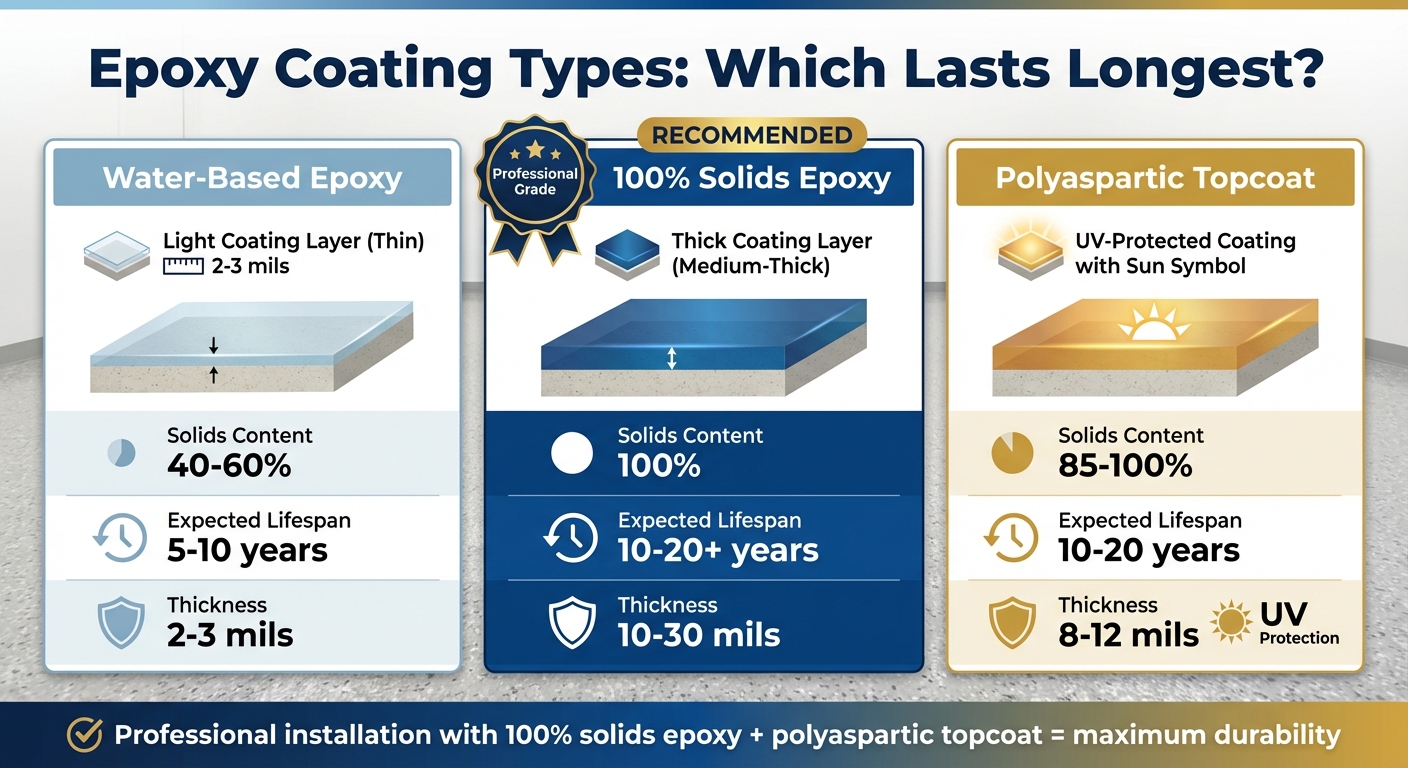
Epoxy Coating Types Comparison: Lifespan, Thickness & Durability
Austin garages endure tough conditions, from intense heat to heavy use. That’s why epoxy flooring stands out – it’s built to last. Unlike other surface options, epoxy creates a durable, mechanical bond with the concrete. When Epoxy Flooring Group works on your garage, we use diamond grinding to open the concrete’s pores. This ensures the epoxy sinks deep into the surface rather than just sitting on top. This meticulous preparation is why professionally installed epoxy floors can last 10 to 20 years – or even longer – while DIY kits often fail within 1 to 5 years.
Professional epoxy systems, with their 15–30 mil thickness, are also far better at handling wear and tear. They resist damage from impacts and abrasions, avoiding issues like hot tire pickup – a common problem in Texas summers.
Types of Epoxy Coatings and How Long They Last
Not all epoxy coatings are created equal. Industrial-grade, 100% solids epoxy is the gold standard. It doesn’t contain evaporative agents, so the applied thickness stays the same after curing. In contrast, water-based epoxies, which only have 40–60% solids, shrink as they dry, leaving a much thinner protective layer.
| Coating Type | Solids Content | Expected Lifespan | Thickness |
|---|---|---|---|
| Water-Based Epoxy | 40–60% | 5–10 years | 2–3 mils |
| 100% Solids Epoxy | 100% | 10–20+ years | 10–30 mils |
| Polyaspartic | 85–100% | 10–20 years | 8–12 mils |
At Epoxy Flooring Group, we use 100% solids epoxy for the base coat, which comes with a lifetime warranty. This material forms a waterproof, non-porous barrier that protects against moisture and chemical damage – perfect for Austin’s humid climate. Combined with expert installation, this ensures a floor that stands the test of time.
Why Professional Installation Matters
The secret to a long-lasting epoxy floor lies in proper surface preparation. In fact, poor preparation accounts for up to 95% of coating failures. That’s why we always conduct thorough moisture testing before starting. Excess moisture can cause problems like delamination and blistering, so addressing it upfront is essential.
"A properly performed epoxy floor coating should last a lifetime in an interior setting like a garage while paint will often begin peeling shortly after installation."
– United Floor Coatings
Our multi-layer system includes a moisture-mitigating primer, a high-build epoxy base coat, decorative flakes, and a protective topcoat. For a standard two-car garage, professional installation typically costs between $2,000 and $4,000. While it’s an investment, the durability and longevity more than make up for it.
Polyaspartic Topcoats for Extended Durability
Austin’s blazing sun can cause standard epoxy to yellow or become brittle over time. That’s why we finish every garage floor with a UV-stable polyaspartic topcoat. These topcoats are highly flexible, allowing the floor to expand and contract with temperature changes without cracking. They’re also about four times stronger than lower-grade epoxy coatings.
"Floortex™ [polyaspartic] is approximately four times stronger than low-end epoxy floor coatings."
– Garage Living
Polyaspartic coatings resist scratches, chemicals, and UV rays, preventing discoloration and chalking. They can handle extreme temperatures, from –30°F to 140°F, and cure quickly – ready for foot traffic in 4–6 hours and vehicle use within 24 to 72 hours. For Austin homeowners, where summer temperatures often soar past 100°F, this UV protection keeps your floor looking great for decades.
What Affects How Long Epoxy Flooring Lasts
Even the most durable epoxy flooring needs proper care to stand the test of time. How long your epoxy floor lasts depends on three main factors: regular maintenance, Austin’s unique climate, and how much wear and tear your garage floor sees. Together, these elements determine whether your investment will keep your concrete protected for decades.
Regular Maintenance Requirements
Simple, consistent upkeep can significantly extend the life of your epoxy flooring. Start by sweeping weekly with a soft broom to clear away abrasive dirt and grit. Use a mop with warm water and a pH-neutral cleaner to keep the surface spotless. For spills, act fast – blot them immediately to avoid stains. Battery acid spills can be neutralized with a mixture of baking soda and water, while tire marks can be treated with a citric acid cleaner and a brush.
To prevent mechanical damage, always lift heavy objects instead of dragging them across the floor. If you’re moving machinery or storage units, lay down plywood sheets to distribute the weight evenly. Adding rubber casters or cushioned pads to furniture and tool stands can also help protect the surface from scratches.
Climate and Environmental Factors
Austin’s climate brings its own challenges to epoxy flooring. High heat and humidity can put extra stress on garage floors, which is why Epoxy Flooring Group uses flexible polyaspartic topcoats. These topcoats are designed to handle temperature fluctuations without cracking.
"High humidity can affect epoxy curing significantly. When there’s too much moisture in the air, it can slow down the curing process… leading to longer drying times and potentially weaker bonds." – Michael Thompson, Chemical Engineer
Another factor to watch out for is moisture seeping up from below the concrete. Signs like lifting or damp spots might mean the moisture barrier is failing. Conducting moisture vapor transmission testing before installation can help avoid these issues. Once cured, epoxy’s nonporous surface resists mold and mildew, which are common in humid environments.
Direct sunlight is another concern, as it can cause standard epoxy to yellow over time. However, UV-stable polyaspartic topcoats keep their brightness even after prolonged exposure to sunlight.
Traffic and Usage Levels
The amount of traffic and how you use your garage also play a big role in the lifespan of your epoxy floor. Our 15–30 mil coatings are built to handle heavy use and last longer in various scenarios. For example, a residential garage used mainly for parking a couple of cars can last 20–30 years with proper care. However, a home workshop with frequent tool drops and heavy equipment might see a shorter lifespan of 10–15 years.
| Usage Level | Typical Environment | Expected Lifespan | Main Stressors |
|---|---|---|---|
| Light Residential | Standard home garage | 10–30 years | Foot traffic, occasional vehicle parking |
| Heavy Residential | Home workshop / Car enthusiast | 10–15 years | Tool drops, chemical spills, frequent vehicle movement |
The thickness of the epoxy coating is crucial. Our professional installations use 15–30 mils of industrial-grade epoxy, which is 5 to 6 times thicker than DIY kits that typically measure around 5 mils. This added thickness provides the impact resistance needed for high-traffic areas like workshops, car enthusiast garages, and even commercial spaces. Additionally, cleaning up spills of oil, gasoline, or chemicals right away is essential – leaving them can weaken the epoxy bond and speed up wear and tear.
sbb-itb-f7063d7
Epoxy Flooring Group‘s Installation Process
The durability of your garage floor heavily depends on how well it’s installed. At Epoxy Flooring Group, we’ve fine-tuned a three-step installation process tailored specifically for Austin’s unique climate and garage conditions. This method ensures a strong, lasting bond for your floor. Here’s a closer look at each step.
Step 1: Concrete Preparation and Moisture Testing
Preparation is everything when it comes to epoxy flooring. Before applying any epoxy, we make sure the concrete is in perfect condition. Our team starts by clearing the area and removing contaminants like oil and grease, which can interfere with bonding. To achieve the best results, we use diamond grinding to create a surface that allows for maximum adhesion.
"One of the most important aspects of a successful resinous floor installation is the preparation of the concrete substrate." – Stonhard
Next, we perform moisture testing. Why? Excess moisture can cause blistering, peeling, or even complete delamination of the epoxy. Once we confirm that moisture levels are safe, we repair any cracks, chips, or divots with resin-based patchers to create a smooth and even surface. This meticulous preparation lays the groundwork for a floor that’s built to last.
Once the concrete is ready and moisture levels are verified, it’s time to apply the epoxy.
Step 2: Applying Industrial-Grade Epoxy
With the surface fully prepped, we apply a thick layer of industrial-grade epoxy, ranging from 15 to 30 mils. This isn’t just a coating – it penetrates the concrete pores, creating a permanent mechanical bond through a chemical reaction between the resin and hardener.
To ensure optimal results, the concrete must have a strength of at least 3,000 PSI. Given Austin’s heat and humidity, we carefully regulate temperature and airflow during the first 24 hours of curing. While the floor becomes walkable within 12–24 hours, it takes 7–10 days to reach its full chemical strength.
Step 3: Adding Custom Finishes and Protective Topcoats
The final step is all about enhancing the floor’s appearance and durability. We offer decorative vinyl flakes in over 140 colors, which can be applied as a full broadcast to create a textured, slip-resistant surface.
For ultimate protection, we use a polyaspartic topcoat. Unlike standard epoxy, polyaspartic is UV-stable, so it won’t yellow or fade under Austin’s intense sunlight. Over time, it retains its original clarity and color. This topcoat is also up to four times stronger than traditional epoxy and flexible enough to handle temperature changes without cracking. Plus, it’s resistant to oil, gasoline, and other chemicals, and can withstand up to 10 pounds of static water pressure.
This comprehensive system, backed by our lifetime warranty, ensures your garage floor remains tough and visually appealing, even under Austin’s demanding conditions.
How to Make Your Epoxy Flooring Last Longer
With the right care, your epoxy flooring can maintain its appearance and durability for up to 20 years. The good news? Keeping it in top shape doesn’t take much time – just a few minutes each week.
Cleaning and Spill Management
Daily sweeping is a must. Use a soft-bristle broom or a microfiber dust mop to keep dirt and grit off the surface. Why? Because tiny particles like sand and dirt can act like sandpaper, dulling your floor’s finish under the weight of shoes or tires.
For a deeper clean, mop your floor weekly with warm water and a pH-neutral cleaner, or mix 2–3 ounces of ammonia per gallon of water. Avoid cleaners like soap, vinegar, citrus-based products, or bleach – these can leave a hazy film and dull the shine. A microfiber mop or a soft foam squeegee works best to avoid scratches.
If oil, gasoline, or any chemicals spill on your floor, clean them up immediately. While epoxy is built to resist these substances, letting them sit too long can cause staining or even chemical damage. Use a clean cloth to blot spills instead of spreading them around.
These cleaning habits lay the groundwork for long-term protection.
Using Floor Protection
Hot tires can leave permanent marks on epoxy floors. To prevent this, place heavy-duty mats under your parking spots, especially during Austin’s sizzling summer months. Entry mats are also helpful – they trap dirt and grit before it gets tracked onto your floor.
When moving heavy items like toolboxes or workbenches, avoid dragging them across the surface. Lift them instead, or use dollies with non-marking rubber wheels to prevent scratches or gouges. Adding felt glides or rubber pads to the legs of furniture and storage units can also help protect the floor. In the winter, be sure to rinse off road salt buildup quickly to prevent a white haze from forming.
These protective measures work hand-in-hand with periodic recoating to keep your floor looking its best.
Recoating with Polyaspartic Every 5–10 Years
Even with the best care, your epoxy floor’s topcoat will eventually show signs of wear. Reapplying a polyaspartic topcoat every 5 to 10 years can restore its shine and protective qualities. In Austin’s intense sunlight, consider inspecting your floor every 2–5 years for signs of thinning, dullness, or small cracks.
A fresh polyaspartic layer not only revives the look of your floor but also enhances its resistance to UV rays, abrasions, and chemicals. At Epoxy Flooring Group, we specialize in quick recoating services that bring your floor back to life – no need for a full reinstallation. When combined with regular cleaning and protective measures, this step ensures your floor remains in excellent condition for decades, showcasing the durability of our professional installation.
Why Choose Epoxy Flooring Group in Austin, TX
When it comes to durable garage floors, Epoxy Flooring Group stands out with over 10 years of experience and a portfolio of more than 400 completed projects in areas like Austin, Leander, and Cedar Park. This extensive track record means we know exactly how Austin’s heat, humidity, and intense UV exposure impact garage floors. More importantly, we know how to create coatings that can handle these challenges. Our expertise ensures a high-quality installation process tailored to Austin’s demanding climate.
Using a proven method, we complete installations in just 1–2 days, utilizing industrial-grade diamond grinding for a bond that’s 5–6 times stronger than what typical DIY kits can achieve. We apply 100% solids epoxy at a thickness that exceeds industry standards, ensuring durability. Each project includes moisture testing, a protective primer, and a UV-stable polyaspartic topcoat to prevent yellowing over time. This meticulous approach results in a floor that’s built to last and requires minimal upkeep.
We stand behind our work with a lifetime warranty for residential garages, covering issues like peeling, hot-tire pickup, and delamination. This means your investment is protected for the long haul. Most installations are ready for foot traffic within 3–4 hours and can handle vehicle traffic in just 24–72 hours.
Whether you’re upgrading your home garage, enhancing a commercial space, or outfitting an industrial facility, we deliver durable, low-maintenance flooring that combines functionality with style. From sleek metallic finishes to custom flake designs, we create floors that not only look great but also add value to your property.
Want to transform your garage? Reach out to Epoxy Flooring Group today for a custom quote and see how professional installation can make all the difference.
FAQs
How can I maintain my epoxy garage floor to ensure it lasts as long as possible?
Keeping your epoxy garage floor in great shape doesn’t have to be a hassle. Start by sweeping or vacuuming regularly to clear away dirt and debris. Once a week, mop the floor with warm water and a pH-neutral cleaner to keep its shine intact and ensure it stays durable. If you spill something, clean it up right away to avoid stains. Steer clear of harsh chemicals, as they can harm the surface. For added protection, consider placing mats or pads beneath heavy equipment or vehicles to guard against scratches or dents. With a little routine care, your epoxy floor can stay looking fantastic for years to come.
How does Austin’s climate impact the lifespan of epoxy garage floors?
Austin’s weather brings specific challenges for epoxy garage floors. The combination of scorching temperatures, intense UV rays, and occasional shifts in humidity can take a toll on these surfaces. Without the right protection, you might see issues like peeling, yellowing, or even cracking as time goes on.
To keep your garage floor in top shape, opting for UV-stable and moisture-resistant coatings, such as polyaspartic, is key. Pairing this with professional surface preparation and installation designed for Austin’s climate can make a big difference in extending the life and performance of your flooring.
Why should I hire a professional instead of using a DIY epoxy flooring kit?
Hiring a professional for your epoxy flooring comes with several benefits, starting with expert surface preparation. This step is crucial to ensure the epoxy adheres properly and delivers the durability you’re looking for. Professionals bring high-quality materials and advanced techniques to the table, achieving a smooth, resilient finish that’s hard to replicate with DIY kits. On top of that, they can personalize the look – whether it’s colors, textures, or finishes – so your garage floor aligns perfectly with your style and needs.
Another big advantage? You save time and avoid the headaches that often come with DIY attempts. Problems like uneven coatings, bubbling, or early wear and tear are common pitfalls when you go it alone. A professional installation results in a tough, low-maintenance surface that stands up to heavy use and can last for decades. It’s an investment that not only enhances your garage’s appearance but also adds lasting value to your home.